Method
Modern Viennese Violin School
A method book grown out of teaching and concert practice: posture, bowing, the left hand, practising, performing, and the interpretation of Baroque, Viennese Classical and Romantic music.
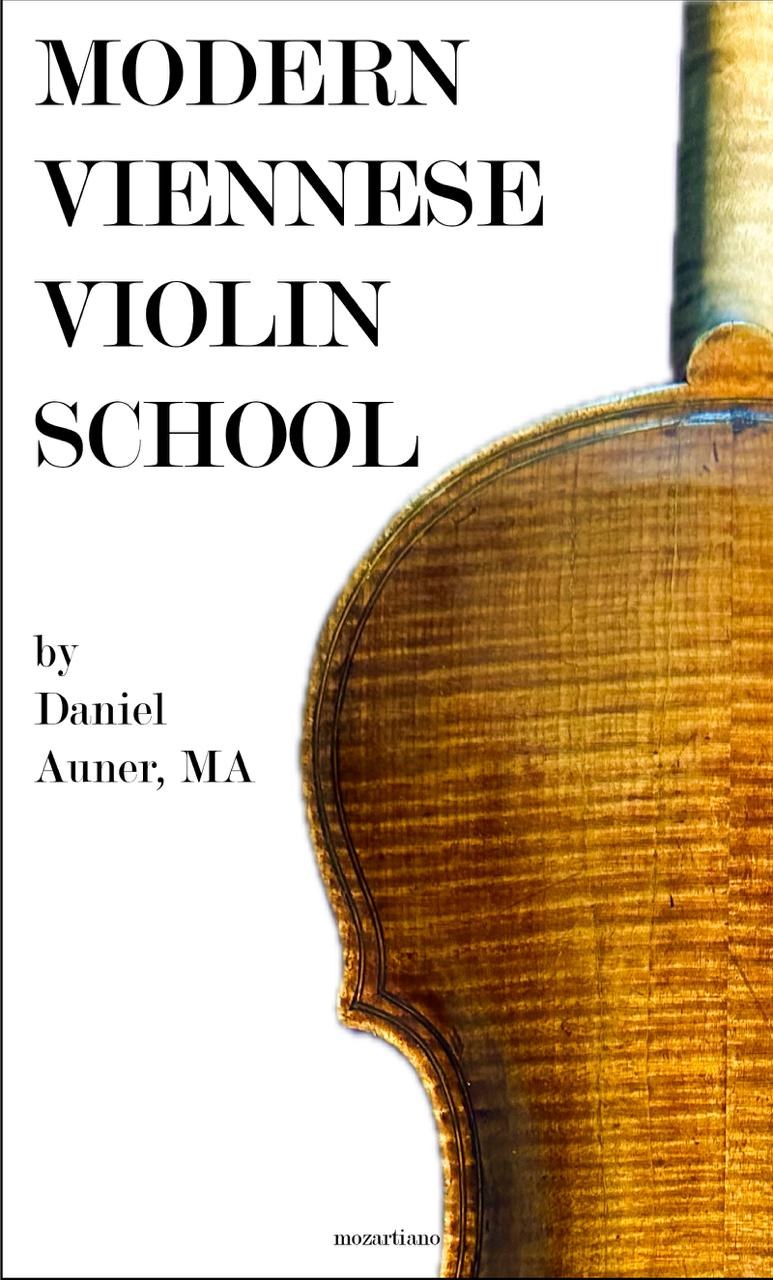
The book is published in English as Modern Viennese Violin School — Original Version, since 17 June 2024, in paperback and as a Kindle edition. A Portuguese version is available in the translation by Sara Pomim de Oliveira.
The chapters at a glance
Introduction
The art of violin playing
The method rests on two pillars. The first is technical development, to which roughly thirty percent of daily practice belongs: open strings, scales, études, caprices. The second is the repertoire piece currently in hand. The second pillar is constantly rebuilt; the first must grow across a lifetime. Anyone who practises scales with their arpeggios daily will learn the first movement of the Beethoven concerto more easily than someone trying to learn the intonation of a D major scale from the concerto itself.
Chapter 1
Posture and holding the violin
The violin was built without regard for ergonomics; only Louis Spohr’s chin rest of 1820, and later the shoulder rest, brought relief. Upright torso, head slightly raised, staggered feet, soft knees as shock absorbers. The music stand belongs at eye level, not lower. When playing without a shoulder rest, the violin rests on the collarbone and the left hand takes on part of the stabilising work.
Chapter 2
Holding the bow
The right hand is responsible for sound quality. The thumb sits bent in the notch of the frog — if a hole forms in the leather, it is about a centimetre too high. The inner tip of the ring finger closes the “bow eye” on the frog, which indicates a naturally rounded hand. The little finger stands beside the ring finger on top of the stick, not stretched over it. The back of the hand continues the line of the forearm.
Chapter 3
The left hand
The thumb touches the neck on the left, at the middle of the upper phalanx — the only constant point of contact. A closed circle forms between first finger and thumb on the G string; any further contact of the palm makes vibrato impossible. In shifting, the hand rotates slightly clockwise so that all four strings remain within reach of the little finger. Against tendonitis: carry nothing heavy in the left hand, avoid playing in the cold, warm water before playing — as Fritz Kreisler preferred.
Chapter 4
The bow stroke
Sound arises from two quantities at the contact point: bow speed and weight. The right elbow stays level with the body of the violin so that the weight of the arm can flow through every joint to the string. At the frog the bow is tilted away from the body and played on half the hair, flattening towards the tip to keep full contact. The bow change follows the image of the cyclist: slow, turn, accelerate — governed by the wrist, not the elbow.
Chapter 5
Vibrato
Vibrato adds overtones and thereby intensity and carrying power, without any adjustment in the right hand. Fritz Kreisler made continuous vibrato common; until the early twentieth century it was used sparingly, chiefly on sustained notes. The movement is a “come here” of the wrist, about twice a second; only the lift costs muscular effort, gravity does the rest. A continuous vibrato should not restart with every new note.
Chapter 6
Shifting
The aim is a shift that is reliable and does not disturb the declamation of the phrase. What counts is hearing and feeling in advance, and the early innervation of the movement. The bow takes part: in long shifts it reduces speed and pressure in step with the diminishing pressure of the shifting finger — not, as is commonly supposed, through an ever faster left hand. Since any single joint produces a circular movement while the fingerboard is straight, the upper arm leads the shift towards the body; the thumb stays entirely relaxed throughout.
Chapter 7
Exercises
Deliberate scratching: at the frog, with full hand weight, produce deliberately unpleasant noise across the whole stroke, maintaining it through the changes — this strengthens the right hand in minutes as ordinary practice does in hours. Finger awareness: divide a stroke into four beats and lift one finger per beat, in front of a mirror. Bow-length awareness, and string crossings from the fingers alone. For the left hand: finger independence after Ševčík or Flesch, shifting through scales and arpeggios. Scales daily, changing key.
Chapter 8
On practising
The greatest learning effect lies in seven to eight repetitions of the same movement — not in duration. David Oistrakh structured practice into four slow, two medium and one fast repetition. Sections should at first be no longer than twenty seconds. Practice should be harder than performance: tap the left-hand fingers audibly onto the fingerboard, use left-hand pizzicato when moving to a lower finger; on the right, divide each note into head, body and feet. Once a piece works, the task shifts from learning to repairing: record, isolate the problem passages, build fast passages from the end backwards.
Chapter 9
On performing
Stage fright is the fight-or-flight response: the pulse rises, time seems to slow. This is why everything should be taken ten percent slower on stage — it will feel too slow and will be the usual tempo. Repeated exposure is the most effective remedy; a soloist who plays a concerto twenty times in a season is left with pleasure rather than pressure. It helps to decide in advance which places in the piece demand full conscious attention and to let the rest run.
Chapters 10–12
Interpreting the epochs
Mendelssohn brought Baroque music back to the concert hall after almost two hundred years; the first printed Bach editions carried Romantic dynamics and bowings and shaped interpretation well into the twentieth century. Affekt — the imitation of human feeling, with language as the model — is the key to the Baroque. The Viennese Classical style requires knowledge of the eight-bar period and its pattern of stress; articulation is to be read from the piano, and a look at the autograph always repays the effort. The Romantic era dissolves four-bar regularity and the metronome becomes secondary — while the unbroken performing tradition is itself a source.
Continue